If we could only bottle the feelings associated with the early stages of a romantic relationship. My goodness, talk about a best-selling product. The reality is that excitement, as we noted recently (see Love? Or Infatuation?), is “associated with the hormones released during the first stage of a relationship.” As we also said, in pointing out the difference between infatuation and love, “If someone thinks that those ‘highs’ are what true love is all about, then they are in a sense addicted to the infatuation associated with a new relationship. But maturity involves recognizing that the peace found in a healthy long-term relationship does not depend on the short-term excitement associated with infatuation.”
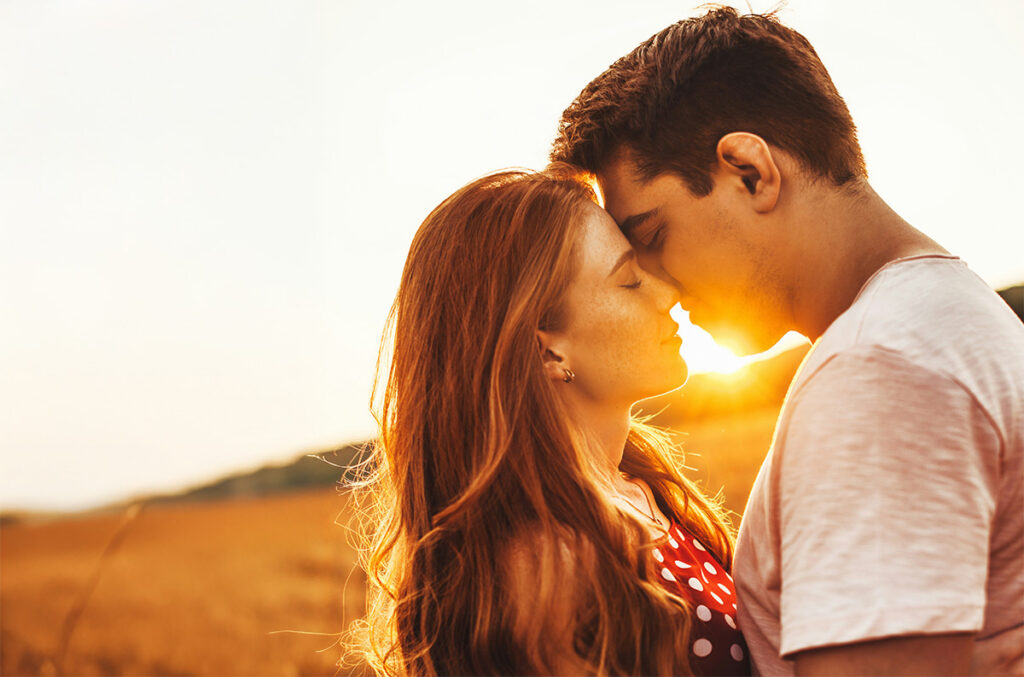
Those insights highlight the fact that the passion and thrill that go along with the early stages of a relationship are destined to subside. Which brings up an interesting question: “How long does that phase of the relationship last, and is it truly destined to pass?” A. Pawlowski, writing for Today.com, turns to research by neurologist Dr. Fred Nour that suggests you should “Expect the passion to last two to three years at most.” That falls in line with the generally accepted phases of a long-term relationship, which follows a chronology that breaks down into four periods (although Nour’s terminology used here uses its own descriptions).
Mate selection. This is the initial quick process of physical attraction, which we touched on recently in Love: An Essential Part Of Our Being. Scientists examine the subject from, naturally enough, the scientific viewpoint, which focuses on love as part of our physical being as opposed to the spiritual aspect. Consequently, as we wrote, it’s no surprise that “Biological anthropologists approach the subject asking a question common to their field: If romantic love exists cross culturally, is there a biological element that contributes to a person’s survival and perpetuation?” Pawlowski agrees with this perspective and reaffirms that the answer is yes, saying “On a basic biological level, you’re attracted to him because your body senses your genes mixed with his genes would produce very healthy children.”
Romance and falling in love. Then comes the fun part that forms the plotline of countless rom-com movies. This is when your body and brain go crazy releasing hormones Why “fun?” Because physical contact is such an integral part of this phase. See The Virtuous Circle Of Feel-Good Hormones, where we wrote, “Many people have heard oxytocin referred to as the ‘love hormone,’ which is indeed accurate in one sense. Research indicates that physical touch of many kinds spurs its release, including hugs, massages, cuddling and sexual activity. That’s why these physical acts are such an important part of the bonding process.” Pawlowski elaborates on why this phase is crucial, saying “This phase has an important purpose: It prepares you for true love down the road.” Before we can get to that final phase, however, there is an interim phase, although the description of this phase can be justifiably debated.
Falling out of romantic love. Pawlowski writes, “Everyone goes through this stage, even the most adoring, passionate couples you know. In a culture that focuses almost solely on romantic love, it can be very alarming when you realize the rush is gone, the passion has vanished, and your spouse no longer makes your pulse race.” Many researchers and psychologists would want to hedge this statement. For some if not many couples, the passion does not vanish; it simply is not ever-present. Parsing the language aside, most psychologists would agree that the romantic stage has a shelf life. What follows in a genuinely deep and healthy relationship is mature love.
True love. In a healthy, long-lasting relationship, both partners see the other without hormone-induced idealization: as they really are, with human strengths and weaknesses. Fortunately, having gone through the romantic stages together, both also have shared memories that contribute to the health of the relationship, helping them to love the “real” other.